Every January, millions of people download a habit tracker.
They commit to exercising every day. Reading more. Drinking more water. Waking up earlier. Learning a language.
For the first week, everything feels different. Checking off each habit is satisfying. Watching the streak grow is motivating. It finally feels like this time will be different.
Then life happens.
You miss one day because work gets busy. Then another because you're traveling. A stressful week throws off your routine. The streak breaks. A few days later, you stop opening the app entirely.
If that sounds familiar, you're not alone.
The problem probably isn't your motivation. And it probably isn't the habit tracker.
The problem is that tracking alone rarely creates lasting follow-through.
Most habit trackers are built to record behavior
Habit trackers do one job exceptionally well. They help you record whether you completed a habit.
Did you work out? Did you read? Did you meditate? Did you drink enough water?
That's useful information. But knowing whether you completed a habit yesterday doesn't necessarily help you complete it tomorrow.
Tracking tells you what happened. It doesn't always help determine what happens next.
Motivation is a great spark. A terrible strategy.
Many people believe they stop using habit trackers because they lose motivation. In reality, motivation was never meant to carry the entire journey.
Motivation changes with your mood, your energy, your workload, your family responsibilities, and your health.
If your system depends on feeling motivated every morning, eventually the system breaks.
The people who stay consistent aren't motivated every day. They simply built a system that keeps them moving when motivation disappears.
A habit doesn't exist in isolation
Most habits aren't important because of the habit itself. They're important because of what they lead to.
Going to the gym isn't the goal. Living a healthier life is.
Reading ten pages isn't the goal. Learning and growing is.
Making five sales calls isn't the goal. Building a successful career is.
When habits aren't connected to something meaningful, it's easy to stop doing them. The habit becomes another box to check instead of a step toward a larger purpose.
Accountability changes everything
Here's something many habit trackers never address.
Who notices when you stop?
Usually, no one. The app quietly records that you missed yesterday. Then today. Then this week. There's no conversation. No encouragement. No reminder of why you started.
That's why accountability matters. Not because someone is there to judge you, but because someone or something reminds you that your commitments still matter.
Real accountability isn't about guilt. It's about helping you become the person you said you wanted to become.
Why people really quit after two weeks
In our experience, most people don't quit because the app wasn't good enough. They quit because the system underneath the app wasn't strong enough.
They had habits without goals. Goals without accountability. Accountability without consistency. Or consistency without a clear reason to keep going.
Eventually the streak ended, and with it, the habit.
The app didn't fail. The system did.
A better way to build consistency
Imagine if your daily habits weren't just isolated checkboxes.
Imagine if they were connected to meaningful goals. Imagine if someone could encourage you when you started slipping. Imagine if your consistency mattered more than a perfect streak.
Imagine if every day ended with one simple question:
Did I do what I said I was going to do today?
That's a different kind of system. That's a personal accountability system.
Where Discipline Rewards fits
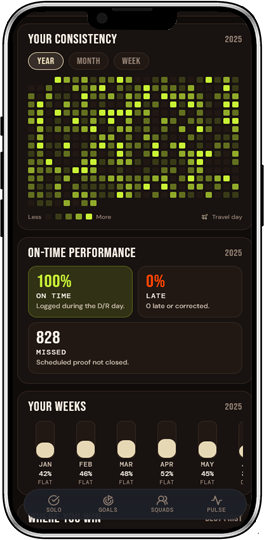
Discipline Rewards includes habit tracking because habit tracking is valuable. But it doesn't stop there.
D/R combines the pieces that help habits become follow-through:
Track daily actions that matter.
Connect habits to larger outcomes.
Use partners and squads for visibility.
Build consistency through daily proof.
Together, those pieces create something larger than a habit tracker. They create a system designed to help you keep the promises you make to yourself.
The goal was never a longer streak
Long streaks are satisfying. But they aren't the point.
The point is becoming someone who consistently follows through. Someone who keeps showing up. Someone who does what they said they were going to do, even when motivation isn't there.
Because that kind of consistency changes far more than your habits. It changes your life.
FAQ
Are habit trackers bad?
Not at all. Habit trackers are useful tools for building awareness and consistency. The challenge is expecting habit tracking alone to create lasting behavior change.
Why do people stop using habit trackers?
For many people, habits become disconnected from meaningful goals, accountability, and daily follow-through. When motivation fades, the system often fades with it.
What makes a personal accountability system different?
A personal accountability system combines habits, goals, accountability, and consistency into one framework. Instead of simply tracking what happened, it helps you stay committed to what matters next.
Can D/R replace my current habit tracker?
Yes. If you're looking for more than streaks and checkboxes, D/R provides habit tracking alongside goals, accountability partners, squads, and daily check-ins to help you build long-term consistency.
Keep going
These D/R pages connect this article to the product system.
Tracking habits is a good start. Following through is better.
The best habit tracker isn't the one with the longest feature list. It's the one that helps you become more consistent over time.
If you're ready to move beyond simply tracking habits and start building discipline through consistency and follow-through, Discipline Rewards was built for you.