Few words in personal development are misunderstood more than discipline.
For many people, the word immediately brings a specific image to mind. They picture someone waking up at 4 a.m., taking cold showers, following a perfectly optimized schedule, and pushing themselves harder than everyone else around them. Because that image is so common, people often reach one of two conclusions: either they're disciplined, or they're not.
The problem is that both conclusions are usually wrong.
Discipline is not a personality trait. It isn't something a select group of people were born with while everyone else was left behind. Discipline is a skill, and like any skill, it can be developed over time. At its core, discipline is simply the ability to follow through on commitments consistently, especially when conditions are less than ideal.
That definition may sound less exciting than the popular version, but it's far more useful. Because if discipline is a skill, then it can be built. And if it can be built, the question changes from "Am I disciplined?" to "How do I become more disciplined?"
That's a much better question.
Most People Focus on the Result Instead of the Process
One reason discipline feels difficult is that people tend to admire outcomes while ignoring what created them.
We see the entrepreneur with a successful company, the athlete in peak condition, the writer who published a book, or the leader who appears incredibly productive. What we don't see are the thousands of small decisions that came before those results.
Discipline is rarely built through dramatic moments. It's built through repetition.
People don't become disciplined because they had one exceptional day. They become disciplined because they repeatedly did what they said they were going to do. Over time, those small acts of follow-through begin to compound. They don't just create results. They create identity.
The person who consistently follows through eventually begins to see themselves differently. That's where real discipline starts to take shape.
The Problem With Willpower
When people decide they need more discipline, their first instinct is usually to rely on willpower.
For short periods of time, that approach can work. A burst of determination can carry you through a difficult week or help you start a new habit. The problem is that willpower is a limited resource.
Every day requires decisions. Work demands attention. Family responsibilities compete for energy. Unexpected problems appear. Stress accumulates. The more pressure life creates, the harder it becomes to rely on willpower alone.
This is why so many people experience the same cycle. They become highly disciplined for a few days or weeks, life gets busy, momentum disappears, and everything falls apart.
The issue isn't always effort. It's that willpower was carrying too much of the load.
People who maintain discipline over the long term usually don't have unlimited willpower. Instead, they've built systems that reduce their dependence on it. Rather than forcing themselves into action every day, they've created structures that make action easier and more automatic.
That's often where real discipline begins.
Discipline Starts Smaller Than Most People Think
One of the biggest misconceptions about discipline is that it requires massive effort.
In reality, discipline is usually built through surprisingly small commitments.
A twenty-minute walk. Ten pages of reading. Five sales calls. Five hundred words written. One meaningful task completed.
None of those actions seem particularly impressive on their own. That's exactly why they work.
Small commitments survive ordinary life. They survive stressful weeks, low motivation, travel schedules, family obligations, and unexpected interruptions. Large commitments often create inconsistency because they require perfect conditions. Small commitments create consistency because they can be completed almost anywhere.
Lowering the size of the action doesn't mean lowering the ambition of the goal. It simply means choosing actions you can repeat long enough for momentum to develop.
Discipline grows through repetition, not intensity.
Your Environment Matters More Than You Think
People often treat discipline as if it's entirely a mindset issue. While mindset matters, environment plays a significant role in behavior.
It's easier to eat healthy when unhealthy food isn't constantly available. It's easier to focus when distractions are removed. It's easier to work out when the workout is already scheduled. It's easier to read when the book is sitting within reach.
These examples reveal something important: disciplined people often spend less time resisting temptation and more time designing environments that support the behaviors they want.
They reduce friction. They make good decisions easier. They make bad decisions harder.
That approach may not feel heroic, but it's incredibly effective.
Discipline isn't always about becoming stronger. Sometimes it's about becoming smarter.
Why Proof Matters More Than Tracking
Most people have tracked something at some point in their lives. Habits, workouts, calories, goals, tasks, or daily routines. Tracking can be useful, but tracking alone doesn't always create discipline.
What's often missing is proof.
Proof creates accountability. It creates honesty. It creates evidence that the work actually happened.
That's one of the reasons D/R emphasizes proof instead of simple completion. A checkmark is easy to tap. Proof requires follow-through.
A photo. A screenshot. A completed deliverable. A written update.
Evidence changes the relationship you have with progress because it becomes difficult to pretend. The work either happened or it didn't.
That clarity strengthens accountability, and accountability strengthens discipline.
Discipline Is Not Punishment
One mistake many people make is turning discipline into punishment.
They create impossible standards, become overly critical of themselves, and treat every setback as evidence of failure. Eventually, they burn out.
Real discipline looks different.
Discipline isn't about suffering. It's about reliability. It's about becoming someone who follows through more often than they don't.
That allows room for mistakes. It allows room for setbacks. It allows room for being human.
The goal isn't perfection.
The goal is consistency.
Once people understand that distinction, discipline becomes far more sustainable. Instead of feeling like a constant battle, it becomes a practice that's strengthened over time through repetition.
The D/R Approach to Self-Discipline
At Discipline Rewards (D/R), we believe discipline grows through a simple cycle:
Commit. Act. Prove. Repeat.
Commit to a specific action. Take the action before excuses gain momentum. Prove the work happened. Then repeat the process tomorrow.
The framework is intentionally simple because most people don't need more complexity. They need more follow-through.
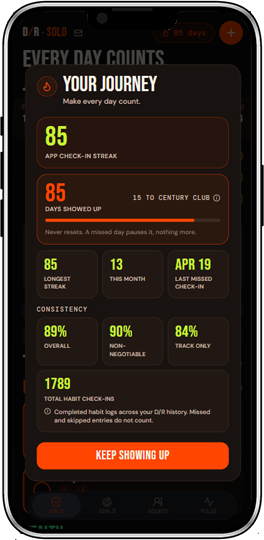
Discipline isn't built through one heroic effort. It's built through hundreds of ordinary actions repeated over time.
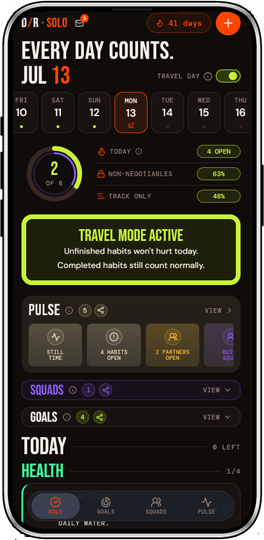
By connecting goals to daily commitments, encouraging visible proof, and creating accountability around execution, D/R helps strengthen the behaviors that discipline depends on.
Over time, those behaviors become habits.
Those habits become identity.
And that identity becomes discipline.
Final Thoughts
Many people spend years searching for discipline as if it's something they need to discover.
In reality, discipline is something they build.
It grows every time you follow through on a commitment. Every time you act when it would be easier not to. Every time your actions match your intentions.
The process is rarely dramatic. More often, it's a series of ordinary decisions repeated long enough to become part of who you are.
That's what discipline really is.
Not perfection. Not toughness. Not suffering.
Just the ability to keep showing up, again and again.
FAQ
Is self-discipline something you are born with?
No. Discipline is a skill developed through repetition, accountability, and consistent follow-through.
How do I build discipline when motivation is low?
Reduce the size of the commitment and focus on action rather than emotion. Discipline grows when behavior continues after motivation fades.
Is discipline the same as willpower?
No. Willpower is temporary. Discipline is a repeatable system of behavior.
What should I do if I keep failing?
Focus on recovery rather than perfection. Return to the next commitment as quickly as possible.
Can accountability help build self-discipline?
Yes. Accountability creates visibility, and visibility makes follow-through more likely.
Keep going
These D/R pages connect this article to the product system.
Build the system behind the goal
Self-discipline is not something you find. It is something you build. Discipline Rewards (D/R) helps you create daily commitments, follow through on them, prove they happened, and repeat the process until discipline becomes part of who you are.