Why accountability partners work
An accountability partner works because another person changes the stakes. The moment your commitment exists outside your private head, it gets harder to soften, reinterpret, postpone, or quietly forget. Someone else can see it. Someone else can support you.
That is the real value. Not motivational speeches. Not guilt trips. Visibility. The useful tension comes from knowing your commitment is visible—not from another person policing you.
Why traditional partnerships often fail
As useful as accountability partners can be, the system often breaks in predictable ways. Schedules drift. Check-ins get skipped. Messages get buried. One person gets busy. The other stops asking. The whole structure depends on mutual consistency that life does not always support.
That does not mean accountability is flawed. It means the mechanism is fragile. D/R makes accountability more durable by reducing dependence on nagging, memory, and awkward check-ins.
Commit. Act. Prove. Repeat.
D/R is built around a simple execution loop that turns vague intention into visible behavior.
Decide the exact action that counts today.
Do the work instead of waiting for motivation.
Leave evidence that the action happened.
Come back tomorrow and keep the promise again.
D/R turns accountability into a visible system
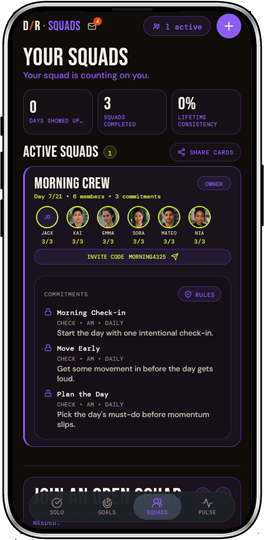
You commit to the action. You do the action. You prove the action happened. You repeat the process tomorrow. That visible record changes behavior because it removes the comfort of vagueness.
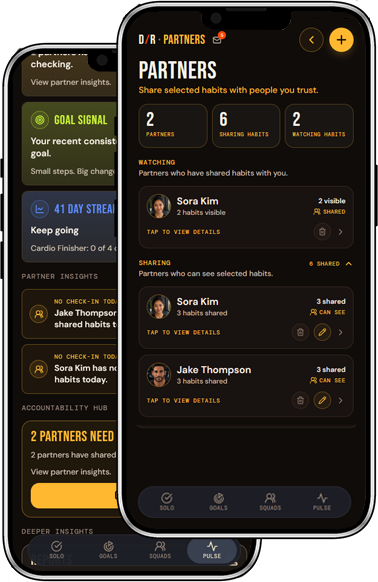
For users who already have a real accountability partner, D/R strengthens the relationship by making the evidence cleaner. Conversations stop revolving around memory and interpretation and start revolving around visible follow-through.
Passive reminders are easy to swipe away
A lot of apps confuse notification volume with accountability. They send another ping, prompt, alert, or badge. But reminders are easy to dismiss because they do not make the commitment visible to anyone else.
Remembering is necessary. Following through is the goal. D/R is designed to make commitments count, not just remind you that they exist.
Make commitments harder to quietly avoid
The emotional pain underneath this category is not just inconsistency. It is the loss of trust that comes from repeated private avoidance. People want fewer loopholes and a clearer view of what they actually did.
D/R gives users a visible record of whether they did what they said they would do. Over time, that record becomes more than a log. It becomes proof that follow-through is becoming part of who they are.
FAQ
Can D/R replace a real accountability partner?
Not completely for every user, but it can recreate much of the useful structure by making commitments and follow-through visible.
What makes D/R different from reminders?
Reminders help you remember. D/R adds commitment, proof, and visibility so accountability does not depend on nagging or guilt.
Can I use D/R with an actual accountability partner?
Yes. D/R can strengthen a real accountability relationship by making the work and evidence easier to review.
Keep going
These D/R resources explain the same system from different angles.
Create Accountability That Lasts
D/R makes follow-through visible without turning your partner into a supervisor. You get useful accountability while the relationship stays supportive.