Most people don't struggle to get started on a goal. They struggle to keep going once the excitement wears off.
That's an important distinction because most advice is focused on helping people begin. We're told to find our purpose, create a vision board, set ambitious goals, read motivational books, or discover a compelling reason why success matters. Many of those things are valuable, especially at the beginning of a new challenge. The problem is that consistency isn't tested at the beginning. Consistency is tested weeks later, when the goal no longer feels new and the emotional momentum that fueled the first few days has faded.
This is where most people start asking themselves a frustrating question: Why can't I stay consistent? They ask it about their health, their finances, their business, their faith, their relationships, and nearly every meaningful goal they pursue. They wonder why they can be fully committed for a few days or even a few weeks, only to find themselves gradually slipping back into old patterns. The answer is usually not that they stopped caring. In most cases, the goal still matters. What changed is that their system depended heavily on motivation and very little on follow-through.
The Myth of Naturally Consistent People
One of the most damaging beliefs in personal growth is the idea that consistency is something certain people are born with. We look at someone who exercises regularly, writes every day, manages their finances well, or spends years pursuing a long-term goal and assume they must possess a level of discipline the rest of us don't have. From the outside, consistency often looks like a personality trait. When you look more closely, it usually looks like structure.
The people we admire for their consistency are not waking up every morning overflowing with motivation. They experience the same distractions, stress, setbacks, and periods of doubt as everyone else. The difference is not that they feel differently. The difference is that they have built systems that continue working even when they don't feel like doing the work. That's an important distinction because it shifts the conversation away from personality and toward process. If consistency is a personality trait, there's not much you can do about it. If consistency is the result of a system, it can be learned, improved, and repeated.
Why Motivation Creates Fragile Progress
Motivation gets far more credit than it deserves when people talk about consistency. Most goals begin with a burst of enthusiasm. You decide to make a change, create a plan, and start taking action. The future feels exciting and progress feels inevitable. During this phase, motivation makes everything easier.
The challenge is that motivation is temporary. As life returns to normal, the emotional energy that made the goal feel effortless begins to fade. Work becomes demanding, schedules become crowded, and progress often feels slower than expected. Nothing has changed about the goal itself. The outcome is still worthwhile. The benefits are still meaningful. What changes is how you feel about the effort required to achieve it.
This is where many people get stuck. They assume they need more motivation when what they actually need is a structure that can survive after motivation disappears. Motivation is an excellent spark, but it is a terrible fuel source. The people who remain consistent over the long term are not the people who stay motivated forever. They are the people who learn how to keep moving after motivation leaves.
Final Thoughts
Most people spend years searching for the secret to consistency. They look for the perfect morning routine, the right productivity system, a new source of motivation, or a strategy that somehow makes follow-through effortless. While those things can be helpful, they often distract from a much simpler truth: consistency is rarely the result of extraordinary effort. More often, it is the result of ordinary actions repeated long enough to matter.
The people who make meaningful progress are not necessarily the most talented, motivated, or disciplined. They are usually the people who continue showing up after the excitement fades. They learn how to act on average days, not just their best days. They stop measuring success by how inspired they feel and start measuring it by whether they followed through on the commitments they made.
That is why consistency is ultimately less about motivation and more about trust. Every time you follow through on a commitment, you create evidence that your word matters. Over time, those small moments accumulate. Confidence grows. Self-trust returns. Progress becomes visible. Not because you found a shortcut, but because you built a habit of showing up.
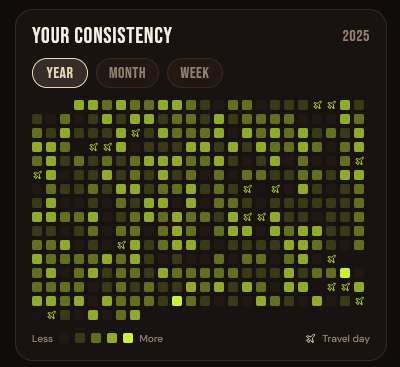
The goal is not perfection. You will miss days. You will fall behind. You will have seasons where life becomes more difficult than expected. What matters is your ability to return. Consistency is not built by never breaking the chain. It is built by refusing to let a missed day become a missed week or a missed month.
In the end, the people who achieve meaningful goals are rarely the people who were motivated every day. They are the people who kept making the next commitment, taking the next action, and moving forward long enough for the results to compound. That's what consistency really is: a series of small promises kept long enough to change the direction of your life.
Commit. Act. Prove. Repeat.
D/R turns follow-through into a simple execution loop that is built for ordinary days, not just motivated days.
Name the action that counts today.
Do the work before excuses take over.
Leave visible evidence that it happened.
Return tomorrow and keep the promise again.
FAQ
Why am I inconsistent even when I care about my goals?
Because caring and following through are different skills. Most inconsistency comes from unclear actions, oversized commitments, or systems that depend too heavily on motivation.
Is consistency more important than motivation?
In the long run, yes. Motivation helps people start. Consistency is what helps them finish.
What should I do after breaking a streak?
Return to the next commitment as quickly as possible. Recovery matters more than perfection.
How do I stay consistent when life gets busy?
Reduce the size of the commitment instead of abandoning it completely. Consistency grows when actions can survive imperfect days.
Can accountability improve consistency?
Yes. Visible commitments and visible proof create accountability, which makes follow-through more likely.
Keep going
These D/R pages connect this article to the product system.
Build the system behind the goal
Consistency is not something you are born with. It is something you build. Discipline Rewards (D/R) helps you turn long-term goals into daily commitments you can act on, prove, and repeat until follow-through becomes second nature.