If you ask most people why they are not making progress on an important goal, the answer is usually some version of the same thing: "I'm just not motivated right now."
It's a reasonable explanation, and one that most of us have used at some point. We assume motivation is the missing ingredient. If we could just find the right book, watch the right video, attend the right conference, or hear the right message, everything would suddenly click into place.
For a long time, I believed that too.
Then I started paying closer attention to people who consistently achieved difficult goals. What stood out wasn't that they were always motivated. Some days they were excited, some days they were exhausted. Some days they felt confident, and other days they felt uncertain. The common thread wasn't how they felt. It was that they kept taking action regardless of how they felt.
That observation raises an important question: if motivation isn't what creates consistent results, what does?
More often than not, the answer is accountability.
Why Motivation Feels So Important
Motivation gets a lot of attention because it's usually where change begins. People decide to lose weight, start a business, improve their finances, strengthen their faith, or pursue a new skill because they feel motivated to do so. Motivation creates excitement, optimism, and belief. Without it, many goals would never get off the ground.
The problem isn't that motivation lacks value. The problem is that people expect it to do a job it was never designed to do.
Motivation is excellent at helping you start. It's much less reliable at helping you continue.
Life has a way of interrupting even the best intentions. Work gets busy. Stress shows up. Family responsibilities expand. Progress takes longer than expected. The excitement that once felt so powerful begins to fade, even though the goal itself still matters.
When that happens, many people assume they need more motivation. In reality, they often need something entirely different.
The Problem With Depending on Motivation
Motivation is emotional, and emotions are naturally inconsistent. Some days you'll wake up energized and focused. Other days you'll feel tired, distracted, frustrated, or overwhelmed.
If your behavior depends on how you feel in a particular moment, your results will always be inconsistent.
This is why so many people find themselves trapped in the same cycle. They start strong, build momentum, lose motivation, fall behind, and then restart again a few weeks later. From the outside, it looks like a discipline problem. More often, it's a system problem.
The system relies too heavily on motivation.
The moment motivation disappears, the entire process collapses. That's not sustainable when you're pursuing goals that require months or years of consistent effort.
What Accountability Changes
Accountability approaches the problem from a completely different angle.
Motivation asks, "Do I feel like doing this today?"
Accountability asks, "Did I do what I said I would do?"
That shift may seem subtle, but it changes everything.
Motivation focuses on feelings. Accountability focuses on actions. Motivation fluctuates from day to day. Accountability creates a standard that exists regardless of mood.
When accountability becomes part of the system, progress is no longer tied to inspiration. Success becomes connected to follow-through.
That's why accountability often succeeds where motivation fails.
Why Accountability Works So Well
Think about how differently people behave when another person is involved.
Someone might skip a workout on their own but show up consistently when a trainer is waiting for them. A project that gets delayed for weeks suddenly gets completed when a client expects it by Friday. Deadlines we create for ourselves are often flexible, while commitments made to others somehow feel far more important.
The reason is simple: visibility changes behavior.
When someone else knows what we've committed to, our actions become harder to ignore. Human beings naturally respond to accountability. That's not a weakness. It's simply part of how we're wired.
The challenge is that traditional accountability isn't always available. Coaches cost money. Friends get busy. Accountability partners lose interest. Check-ins become less frequent over time.
That's where system-based accountability becomes valuable.
The Three Forms of Accountability
Most people think accountability only comes from another person, but there are actually three forms that matter.
The first is public accountability, where other people know what you've committed to. Friends, family members, coaches, coworkers, and communities can all create this kind of pressure.
The second is private accountability, which is the relationship you have with yourself. It comes from honestly evaluating whether you've followed through on the commitments you've made.
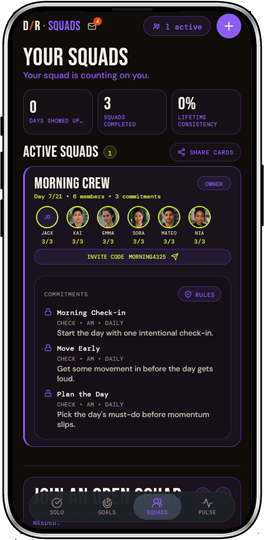
The third is system-based accountability, where a process or framework makes your commitments visible and creates a record of your actions over time.
This is the category where D/R operates.
The goal isn't to replace human accountability. The goal is to make follow-through visible enough that it becomes difficult to ignore.
Reminders Aren't the Same Thing as Accountability
One of the biggest misconceptions in productivity is the belief that reminders and accountability are interchangeable.
They're not.
A reminder asks, "Did you remember?"
Accountability asks, "Did you do it?"
Most people aren't struggling because they forgot their goals exist. They already know what they should be doing. The challenge isn't awareness. The challenge is execution.
A reminder can help bring something to your attention. Accountability helps ensure that attention turns into action.
That's why so many productivity tools feel useful without actually changing behavior. They remind people constantly, but they don't create any meaningful form of accountability.
The D/R Philosophy
At D/R, we believe most people don't need another motivational quote, another inspirational video, or another productivity hack.
They need a better system.
That system is built around a simple loop:
Commit. Act. Prove. Repeat.
Commit to the action. Take the action. Prove it happened. Repeat the process tomorrow.
The framework works because it shifts attention away from emotion and toward behavior. Instead of asking whether you feel motivated, it asks whether you followed through.
For long-term progress, that's a far more useful question.
Motivation Still Matters
None of this means motivation is unimportant.
Motivation is often the spark that starts the journey. It helps people identify meaningful goals and believe change is possible. The mistake is expecting that spark to carry the entire process.
Motivation is a starting point.
Accountability is the structure that keeps things moving after the excitement fades.
The strongest systems use both. Motivation helps you decide what matters. Accountability helps you continue when life becomes inconvenient.
Final Thoughts
Motivation is powerful, but it is temporary. It comes and goes based on circumstances, emotions, energy levels, and countless factors outside your control.
Accountability is different.
It works on the days when you're excited and on the days when you're exhausted. It works when progress feels easy and when progress feels painfully slow. Most importantly, it continues working long after the emotional high has disappeared.
That's why accountability tends to produce more consistent results than motivation.
Not because motivation lacks value.
Because accountability survives reality.
FAQ
Is accountability better than motivation?
For long-term execution, usually yes. Motivation helps people start. Accountability helps people continue.
Can an app create real accountability?
Yes. If commitments and follow-through are visible, an app can create meaningful accountability even without another person involved.
What is the difference between reminders and accountability?
Reminders help you remember. Accountability helps you follow through.
Do I still need motivation if I have accountability?
Yes. Motivation helps identify meaningful goals. Accountability helps maintain action after motivation fades.
Why does accountability improve follow-through?
Because visible commitments create responsibility, and responsibility influences behavior.
Keep going
These D/R pages connect this article to the product system.
Build the system behind the goal
Motivation may help you start. Accountability helps you finish. D/R creates a visible system of commitments, proof, and follow-through so progress does not disappear when motivation does.