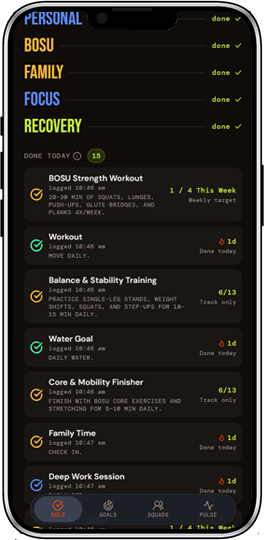
Most people understand why trust matters in relationships.
If a friend repeatedly breaks their word, trust begins to erode. If a coworker consistently misses deadlines, confidence in their reliability starts to disappear. If a company continually fails to deliver on its promises, customers eventually stop believing what it says.
We recognize this pattern almost instinctively when it involves other people.
What many people fail to realize is that the exact same process happens internally. Every time you make a commitment to yourself and fail to follow through, your brain takes note. It may not feel significant in the moment. Missing a workout, postponing a project, delaying an important conversation, or putting off a goal until next week can seem harmless on its own. The problem is that these moments rarely happen in isolation.
Over time, broken promises accumulate. Eventually, the issue is no longer the missed workout or unfinished project. The issue is that you stop fully believing your own commitments. You begin approaching your goals with skepticism because experience has taught you that your intentions and your actions don't always align.
That's why learning to keep promises to yourself is about far more than productivity. At its core, it's about rebuilding trust with the person you spend every day with: yourself.
Why We Overpromise Ourselves
One of the most common reasons people struggle to keep promises to themselves is that they create commitments for an idealized version of who they are.
Motivation has a way of making us overly optimistic. We imagine waking up early every day, exercising consistently, eating perfectly, staying focused for hours, and never procrastinating. The plan feels realistic because we're creating it while feeling energized and inspired.
The problem is that the person making the promise and the person responsible for keeping the promise are often operating under completely different conditions.
The version of you creating the plan may be motivated. The version of you executing the plan might be tired, stressed, distracted, overwhelmed, or dealing with unexpected challenges. That's where many commitments begin to break down.
The issue isn't always a lack of discipline. Often, the issue is that the commitment was never designed for real life. It was designed for your best day rather than your average day.
This is why smaller promises are often more powerful than larger ones. Smaller promises are easier to keep. Kept promises build trust. Trust creates momentum. Momentum makes larger goals feel achievable.
The path to greater self-trust usually starts by making commitments that are realistic enough to survive ordinary life.
Self-Trust Is Built Through Evidence
People often talk about confidence as though it's something you can create through positive thinking alone. While optimism has its place, lasting confidence is usually built on evidence.
Think about the people you trust most. You trust them because they've consistently done what they said they would do. Their reliability has been demonstrated through action.
The same principle applies to your relationship with yourself.
Every time you follow through on a commitment, you create evidence. Every time you complete a task you said you would complete, show up when you said you would show up, or finish something you promised yourself you would finish, you reinforce the belief that your word matters.
This is why proof is so important.
Proof turns intention into something visible. It creates a record of what actually happened rather than what you hoped would happen. Instead of relying on memory or emotion, you have evidence that you followed through.
Over time, those small pieces of evidence begin to change the way you see yourself. Confidence becomes less about hope and more about experience. You trust yourself because you've repeatedly demonstrated that you can be trusted.
The Danger of Constant Negotiation
Most people don't consciously decide to abandon their commitments.
Instead, they negotiate them.
The workout gets pushed to later. The project gets moved to tomorrow. The difficult conversation gets postponed until next week. Each individual decision feels reasonable in the moment, which is why this pattern can be so difficult to recognize.
The problem is that repeated negotiation slowly weakens trust.
Every delay teaches your brain that commitments are flexible. Every excuse becomes evidence that the promise wasn't really a promise. Eventually, your mind stops taking your commitments seriously because experience suggests they will simply be renegotiated later.
This doesn't mean life never gets in the way. Circumstances change. Emergencies happen. Plans occasionally need to adapt. The danger comes when adaptation becomes a habit rather than an exception.
Keeping promises to yourself often requires reducing the amount of negotiation that happens after the commitment has been made.
Why Small Wins Matter More Than Big Plans
People naturally gravitate toward ambitious goals because ambitious goals feel exciting. What often gets overlooked is that self-trust isn't built through ambition. It's built through completion.
A person who commits to a twenty-minute walk every day and follows through consistently will usually build more confidence than someone who creates an elaborate fitness plan and abandons it after two weeks.
The same principle applies to almost every area of life.
Small actions completed consistently create stronger foundations than large plans repeatedly abandoned. This is because self-trust is cumulative. It grows one commitment at a time.
Every promise kept adds another piece of evidence. Every completed action reinforces the belief that you are someone who follows through. Over time, those small wins begin changing your identity. You stop seeing yourself as someone who starts and stops. You begin seeing yourself as someone who can be counted on.
That shift changes everything.
Final Thoughts
Most people spend years trying to improve their habits, productivity, discipline, or motivation. Few spend much time thinking about self-trust, even though it sits underneath all of those things.
The stronger your self-trust becomes, the easier it is to pursue meaningful goals. You spend less time wondering whether you'll follow through and more time taking action. You rely less on motivation because you have evidence that you can act even when motivation is absent. You stop looking for confidence and start building it.
The good news is that self-trust doesn't require a dramatic transformation. It isn't built through one heroic effort or one perfect month. It's built through a series of small promises kept over time.
Every commitment honored becomes evidence. Every act of follow-through strengthens the relationship you have with yourself. Eventually, those moments begin to compound. Goals feel more achievable. Confidence grows. Progress becomes easier to sustain.
Not because you became a different person.
Because you became someone who believes their own word.
Commit. Act. Prove. Repeat.
D/R turns follow-through into a simple execution loop that is built for ordinary days, not just motivated days.
Name the action that counts today.
Do the work before excuses take over.
Leave visible evidence that it happened.
Return tomorrow and keep the promise again.
FAQ
Why do I keep breaking promises to myself?
Most people overcommit, rely on motivation, or create commitments that are too large to survive ordinary life.
How do I rebuild trust in myself?
Start making smaller promises and keeping them consistently. Self-trust is built through evidence, not intention.
Should I lower my standards?
No. Lower the size of the commitment, not the importance of the goal.
How do I stop overcommitting?
Focus on what you can realistically complete today instead of creating plans designed for your ideal future self.
Can accountability help with self-trust?
Yes. Accountability creates visibility, and visibility creates evidence. Evidence is what strengthens trust.
Keep going
These D/R pages connect this article to the product system.
Build the system behind the goal
Self-trust does not come from positive thinking. It comes from evidence. Discipline Rewards (D/R) helps you make daily commitments, follow through on them, prove they happened, and repeat the process until confidence becomes something you have earned.