Motivation has a great reputation.
It's featured in books, podcasts, keynote speeches, social media posts, and nearly every success story we encounter. When people decide they want to improve their lives, motivation is often the first thing they look for. They search for the right video, the right book, the right quote, or the right mindset shift that will finally help them make progress.
At first glance, that makes perfect sense. Motivation feels powerful. It creates excitement, energy, and the belief that change is possible. Most meaningful goals begin with some form of motivation. A person decides they want to improve their health, strengthen a relationship, grow a business, deepen their faith, or finally take action on something they've been postponing for years.
The problem isn't that motivation lacks value. The problem is that motivation is temporary. Because it is emotional by nature, it rises and falls based on circumstances, energy levels, stress, and countless other factors outside our control. That makes it a poor foundation for goals that require months or years of consistent effort.
This is why consistency almost always beats motivation. Not because motivation doesn't matter, but because consistency continues working long after motivation disappears.
The Beginning Is Rarely the Problem
When people fail to achieve a goal, they often assume the problem was a lack of motivation. What's interesting is that most goals don't fail at the beginning. The beginning is usually the easiest part.
The beginning is exciting because everything feels possible. This is the phase where people buy the running shoes, sign up for the gym, download the app, order the books, create the plan, and tell everyone what they're about to accomplish. Energy is high and commitment feels effortless.
The challenge begins a few weeks later.
The goal still matters, but the novelty has disappeared. Progress feels slower than expected. Daily responsibilities return. The emotional momentum that made action easy begins to fade. This is where many people become confused. They still care about the outcome, yet their behavior starts changing. Workouts get skipped. Projects get delayed. Habits become inconsistent.
Most people respond by looking for another burst of motivation.
What they actually need is a system capable of working without it.
Why Motivation Fades
One reason people become frustrated with themselves is because they assume motivation should remain constant. When it starts fading, they interpret that change as a sign that something is wrong.
In reality, motivation is simply an emotion, and emotions are never constant.
Some days you'll wake up energized and focused. Other days you'll feel tired, distracted, stressed, or overwhelmed. That's not a character flaw. It's part of being human. The challenge is that goals continue to exist regardless of how you feel. The business still needs attention. The workout still needs to happen. The difficult conversation still needs to take place.
When people depend too heavily on motivation, they unintentionally create a system that only works on good days. Unfortunately, meaningful goals aren't achieved exclusively on good days. They're achieved on ordinary days, when motivation is average or missing entirely.
That's where consistency becomes valuable. Consistency removes the requirement that you feel inspired before taking action.
Why Consistency Creates Results
Consistency isn't particularly exciting, which is one reason people underestimate its value. There is nothing dramatic about showing up repeatedly and doing the same thing over and over again. It doesn't create viral stories or overnight transformations.
Yet almost every meaningful achievement is built that way.
Businesses grow through repeated effort. Relationships improve through repeated attention. Health improves through repeated choices. Skills develop through repeated practice. Goals are achieved through repeated action.
The power of consistency comes from compounding. One workout rarely changes your health. One sales call rarely changes your business. One day of healthy eating rarely changes your weight. Individually, these actions seem insignificant. Repeated hundreds of times, they become transformative.
People often assume extraordinary results require extraordinary actions. More often, extraordinary results come from ordinary actions repeated for an extraordinarily long time.
Why Consistency Builds Self-Trust
Consistency doesn't just create external results. It changes the relationship you have with yourself.
Every time you follow through on a commitment, you create evidence. Every time you abandon a commitment, you create evidence as well. Over time, those experiences shape your expectations about who you are and what you're capable of.
A person who repeatedly follows through begins trusting their own word. A person who repeatedly abandons commitments begins questioning it.
This is why consistency creates confidence. Confidence isn't something that magically appears. It grows from evidence. You trust yourself because you've seen yourself follow through. You believe in your ability because you've repeatedly acted even when it wasn't convenient.
Consistency isn't only producing results.
It's producing identity.
Final Thoughts
Motivation deserves a lot of credit. It helps people begin. It creates excitement, possibility, and the belief that change can happen. Most meaningful goals start with a moment of motivation.
The mistake is expecting motivation to carry the entire journey.
Motivation comes and goes. Some days it will be abundant. Other days it will be completely absent. If your progress depends on motivation being present, your results will always be inconsistent because your emotions are inconsistent.
Consistency works differently. It doesn't require the perfect mood, the perfect schedule, or the perfect circumstances. It simply requires a willingness to keep showing up, even when the excitement is gone. Over time, those ordinary moments of follow-through begin to compound. Progress becomes visible. Confidence grows. Self-trust returns.
That's why consistency beats motivation in the long run.
Not because motivation is unimportant, but because consistency survives reality. And reality is where goals are either achieved or abandoned.
Commit. Act. Prove. Repeat.
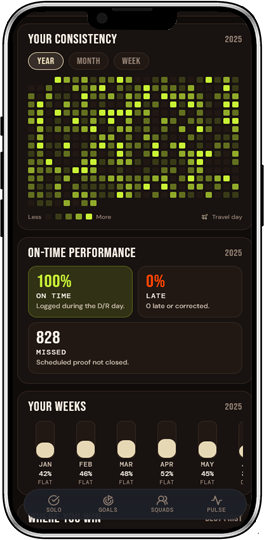
D/R turns follow-through into a simple execution loop that is built for ordinary days, not just motivated days.
Name the action that counts today.
Do the work before excuses take over.
Leave visible evidence that it happened.
Return tomorrow and keep the promise again.
FAQ
Is motivation useless?
No. Motivation is extremely useful for getting started. The problem is expecting it to stay forever.
Why do I lose motivation so quickly?
Because motivation is an emotion, and emotions naturally fluctuate. That is normal.
Can consistency exist without motivation?
Yes. Consistency is built through systems, commitments, and repeated action rather than emotional momentum alone.
What is more important for long-term success?
Consistency. Motivation may start the journey, but consistency usually determines where it ends.
How can I become more consistent?
Focus on smaller daily commitments, visible proof, accountability, and a repeatable process rather than waiting for motivation to return.
Keep going
These D/R pages connect this article to the product system.
Build the system behind the goal
If you are tired of starting strong and falling off when motivation disappears, build a system that does not depend on motivation. Discipline Rewards (D/R) helps you create daily commitments, follow through on them, prove they happened, and repeat the process until progress becomes visible.