Most goals do not fail all at once
The strange thing about goals is that most people do not struggle to set them. Every year, people decide they are going to lose weight, start a business, get out of debt, strengthen their faith, improve their health, spend more time with family, or finally tackle the project they have been putting off for months.
For a few days, sometimes even a few weeks, everything feels different. The goal feels real. The future feels exciting. Progress feels inevitable.
Then life quietly returns. Work gets busy. The kids need attention. A stressful week appears. Energy drops. A workout gets skipped. A project gets delayed. A habit gets missed. Nothing dramatic happens. The goal simply begins fading into the background of everyday life.
That is how most goals die: not because people stop caring, but because today's action becomes optional.
The gap between wanting and doing
One of the most frustrating truths about personal growth is that wanting something does not automatically create action. You can genuinely want to get healthier and still skip the workout. You can genuinely want to grow your business and still avoid the sales calls. You can genuinely want to strengthen relationships and still allow other responsibilities to crowd out the time that matters most.
This is the intention-action gap: the distance between what you intend to do and what you actually do. When that gap shows up, people often assume they need more discipline, more motivation, or more willpower.
More often than not, the issue is simpler. They have a goal. They do not have a system.
Why motivation is not enough
Motivation gets a lot of attention because it feels powerful. When you are motivated, everything seems easier. You feel optimistic. You can clearly imagine a better future and feel excited about creating it.
The problem is that motivation is emotional, and emotions are constantly changing. Some mornings you wake up energized and focused. Other mornings you feel tired, distracted, stressed, or completely uninterested. That is normal. The mistake is expecting motivation to remain constant.
The goals that survive are usually attached to a system rather than a feeling. Progress depends less on how you feel and more on what you do when you do not feel like it.
Why most goals stay too abstract
Goals like "get healthier," "grow the business," "write a book," "save more money," and "become more disciplined" provide direction, but they do not provide action. A goal can tell you where you want to go without telling you what to do next.
When the next step is not obvious, procrastination becomes much more likely. We overthink. We delay. We convince ourselves we will start tomorrow. We wait for a better moment.
The goal itself is not the problem. The missing next action is the problem.
The power of daily commitments
One of the most useful shifts you can make is moving attention away from outcomes and toward commitments. Outcomes matter because they provide direction. Commitments matter because they create progress.
If your goal is to lose thirty pounds, today's commitment might be a twenty-minute walk after dinner. If your goal is to grow revenue, today's commitment might be contacting five qualified prospects before lunch. If your goal is to write a book, today's commitment might be writing five hundred words before opening social media.
The goal remains important, but the focus shifts to something specific, measurable, and achievable today.
Commit. Act. Prove. Repeat.
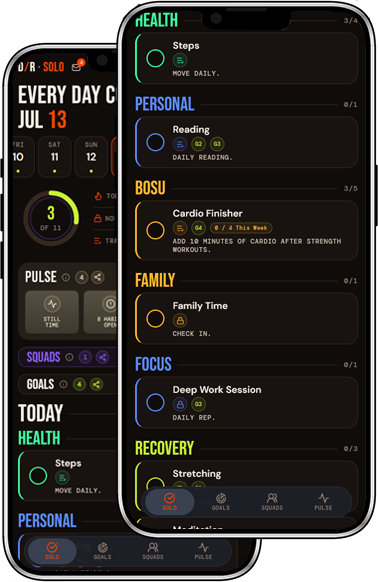
D/R turns follow-through into a simple execution loop. The framework is intentionally simple because follow-through is already difficult enough.
Name the action that counts today.
Do the work before excuses take over.
Leave visible evidence that it happened.
Return tomorrow and keep the promise again.
The goal is not complexity. The goal is consistency.
Why proof matters
Most people think accountability comes from another person. Sometimes it does. But another powerful form of accountability comes from evidence.
A completed workout. A screenshot. A photo. A finished deliverable. A written reflection. The format does not matter nearly as much as the existence of evidence.
Proof creates honesty. Proof creates visibility. Proof turns intention into something tangible. When you can look back and see evidence of your follow-through, confidence begins to grow because you have proof that you did the work.
The hidden cost of broken promises
When people fail to follow through, they usually focus on the obvious consequences. They did not lose the weight. They did not grow the business. They did not finish the project.
What often gets overlooked is a second cost: every broken promise quietly damages trust with yourself. Over time, your commitments start feeling more like suggestions than promises.
The opposite is also true. Every completed commitment strengthens self-trust. Every action becomes evidence. Every follow-through becomes a vote for the person you are trying to become.
What happens when you miss a day
At some point, you are going to miss. Everyone does. The people who achieve meaningful goals are not people who never fall off track. They are people who return quickly.
Most goals are not destroyed by a missed day. They are destroyed by the story that follows: "I already messed up," "I will restart next week," "I need a better plan," or "I will wait until things calm down."
A better response is simpler. Return to the next commitment. Do not wait for Monday. Do not wait for motivation. Do not wait for the perfect plan. Just return.
A quick checklist for following through
- Write the goal in outcome language, then translate it into today's action.
- Make the daily commitment observable: a number, a completed task, a time block, or proof.
- Choose when the action will happen before the day starts negotiating with you.
- Track completion honestly. Partial effort is useful context, but it is not the same as completion.
- Review the pattern weekly so the system improves instead of becoming another abandoned dashboard.
FAQ
Why do I set goals and still not act on them?
Because goals and actions are different things. Most people know what they want, but they never consistently convert that desire into daily commitments.
How do I follow through when motivation disappears?
Reduce the focus on motivation and increase the focus on systems. Clear commitments, visible proof, and accountability help create action when feelings are unreliable.
What is the difference between a goal and a commitment?
A goal is the destination. A commitment is the next action that moves you toward that destination.
Does accountability really help?
Yes. People are far more likely to follow through when commitments and progress become visible.
What should I do after missing a day?
Return to the next commitment as quickly as possible. Recovery matters more than perfection.
Keep going
These D/R pages connect this article to the product system.
Stop treating goals like ideas
Discipline Rewards (D/R) helps you turn goals into daily commitments you can act on, prove, and repeat until progress becomes visible.